
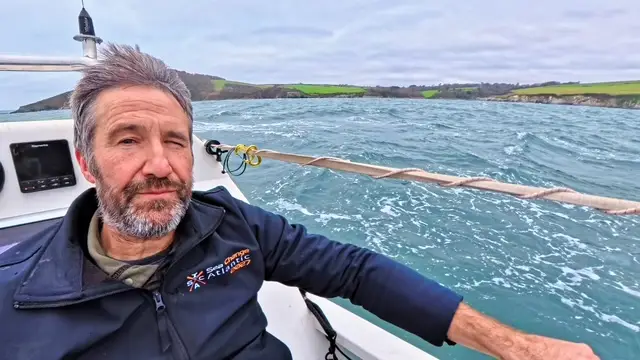
In January 2027, registered blind, Adam Benjamin will be rowing 3,200 miles across the Atlantic Ocean to raise £100,0000 for Parkinson’s UK.
Eye Matter was contacted by Adam, who is part of this four-person crew, Sea Change Atlantic, to help promote his experience as a blind rower navigating the world’s second largest ocean (41 million square metres). Initially aiming to raise money for Parkinson’s UK, he admits, ”I’m doing this row for a variety of reasons, chief amongst them is my desire to prove to people that blind and partially sighted people can take on any challenge they want so long as they do their homework and get themselves organised.”
In September, as part of their training, they will be doing their longest row yet – a 48-hour row along the southern coast of Cornwall. Adam explains, “This will help us get into our expedition rowing routine of 2 on, 2 hours off, 24 hours a day. Like when we’re crossing the Atlantic.”
He has a unique approach to sight-loss awareness training for his sighted crew members, “half of this row will be undertaken at nighttime, meaning that the other crew members won’t be able to see any more than me for at least half the row!”
For Adam, rowing is a sport that is largely based on feel: “You feel your oar in the water, then pull. It’s a rhythmic sport so no matter how little sight you have, if you can follow a rhythm and use the audible cues you get, you can keep in time and add to the boat’s momentum. It’s a great team sport, and if you like your sport to be on the sociable side, then you’ll love rowing as there’s usually a pint at the end of the row!”
However, it hasn’t all been plain sailing for Adam. Moving out of London to Cornwall, Adam encountered a lack of awareness of the needs of visually impaired people within sport, “I moved from South West London to Cornwall about 6 years ago. They didn’t have an equivalent of Metro Blind Sports here, so I joined the local rowing club as that was literally the only organised sports club. I had lots of battles around things like health and safety, insurance and general prejudice before that rowing club allowed me to row. Eventually they accepted me, I rowed with them, I raced with them, and then I went on to captain their men’s crew to its best finish ever in our national competition.”
He feels that when sports people come into contact with a blind person, they automatically see barriers. How will he get in the boat? How will he know when to put his oars in the water? Will he hit someone with his oars? Adam continues, “As a visually impaired person, I see it as my job to show that blindness shouldn’t be a barrier to sporting achievement. Sometimes you have to educate the sighted world to show them what you can do. Other times you just have to get your elbows out and not take no for an answer.”
Adam became determined to turn this experience around,” It took me too long to become accepted. It worried me that other blind people might have just given up. Hence, I decided I needed to do something to show our community that eyesightshouldn’t be a barrier to rowing.”
Aware that January on the Northern Atlantic can be rough for a small rowing boat, to avoid frequent storms, strong trade winds, large swells and severe temperature changes, a decision was made to start further south. They discussed a unique challenge: a 3,200-mile, 50-day Atlantic row starting in Lanzarote, which is one of Spain’s Canary Islands, off the northwest coast of Africa, about 125 kilometres west of Morocco. Although January is the prime time for this East to West crossing, they may still encounter steady northeast trade winds, moderate to strong seas, and warm but cooler nights. The four crew members will be rowing without an accompanying support boat towards the beautiful coastline of Antigua, which is one of the two major islands that make up the Caribbean nation of Antigua and Barbuda.
Over the past 18 months, the crew have collected a variety of support for the project. They have been fortunate to find corporate sponsors who have helped them purchase their specialist ocean rowing boat. Three charities have also supported their efforts – Boost Charitable Trust, the Sports Foundation for the Disabled, and the Rowing Foundation.
Adam continues, “You might be wondering why we chose Parkinson’s as our cause, rather than a sight-loss related charity. The answer to this is simple – my father has Parkinson’s, and I want to give something back to the charity that has supported him so fantastically through his Parkinson’s journey.”
You can make a donation here: – Donate to Rowing 3,200 miles across the Atlantic for charities, organized by Adam Benjamin. Click here for a video about Adam and to follow them on Facebook: